

Youth Talks · First edition 2022-2023
Our results
Amplifying the voices of the youth: they spoke up, we listened.
Youth Talks:
first edition
Youth Talks transcends the boundaries of traditional surveys
01
6 languages
02
Open-ended questions
03
2,300 ambassadors
04
A.I. analysis
Participants
Ambassadors
Contributions
Countries and territories
Three ways to explore
the results
Youth Talks uses state-of-the-art A.I. technology to analyse responses, enabling contributors to answer open-ended questions and distilling close to one million uncensored contributions into rich, comprehensible and actionable insights.
Navigate the digital report
For those who would rather soar through a forest of pages than trudge through them: the digital report is the fastest way to explore and enjoy the results.
NavigateDiscover the question boxes
Get ready to make a splash in the data pool: global ideas, regional gems and the juiciest insights, question by question.
DiscoverExplore the media libraries
Tune in, watch and listen first hand to the vibrant thoughts of young people collected during the consultation.
ExploreRead the
reports
Two documents to download: the global report, in English and in French, and the methodology note.

PDF · English / French
The global report
Here it is, the report that has it all: not a simple rundown of the results but the whole story of Youth Talks.
PDF · Research
The methodology note
The scientific guarantee of the project: the reference if you are a researcher or want to see behind the scenes of Youth Talks.
As a preamble to a long-term project, these documents provide a first descriptive overview of the data. Its richness will require experts from different disciplines and regions to carry out a full, in-depth analysis of the Youth Talks results.
User guide
How to read
the results?
The Youth Talks consultation relies on a unique and innovative methodology. Its results cannot be interpreted as those of traditional surveys.
Since each participant could give several answers per question, the cluster percentages relate to the weight given to each idea across all the people who answered the question analysed. The questions are open-ended and deliberately formulated very broadly, which produces a very significant diversity of responses and themes.
Thus, a macro-cluster shared by 10% of respondents is considered particularly significant. Sub-clusters are more finely detailed and are considered significant from 3% of participants, depending on the question.
The scale of the consultation means that very few ideas do not surface at all. Rather than noting whether they are present in the corpus, it is much more valuable to observe the relative weight of each idea compared with others, and the variations according to participant segment.
Geographic breakdown
Seven zones,
one world
In this analysis, the world is divided according to the geographical zones established by the World Bank: North America, Latin America and the Caribbean, Europe and Central Asia, Middle East and North Africa, Sub-Saharan Africa, East Asia and the Pacific, and South Asia.
This classification into seven clearly defined regions provides a good balance between accuracy and simplicity. It is widely recognised and used internationally in research and public policy, so our results are more easily understood by researchers, decision-makers and international partners.
The World Bank classification is based on geography and income, which makes it particularly relevant to the socio-economic questions explored by Youth Talks. It allows the results to be presented in context and reveals regional nuances in young people’s perspectives and priorities.
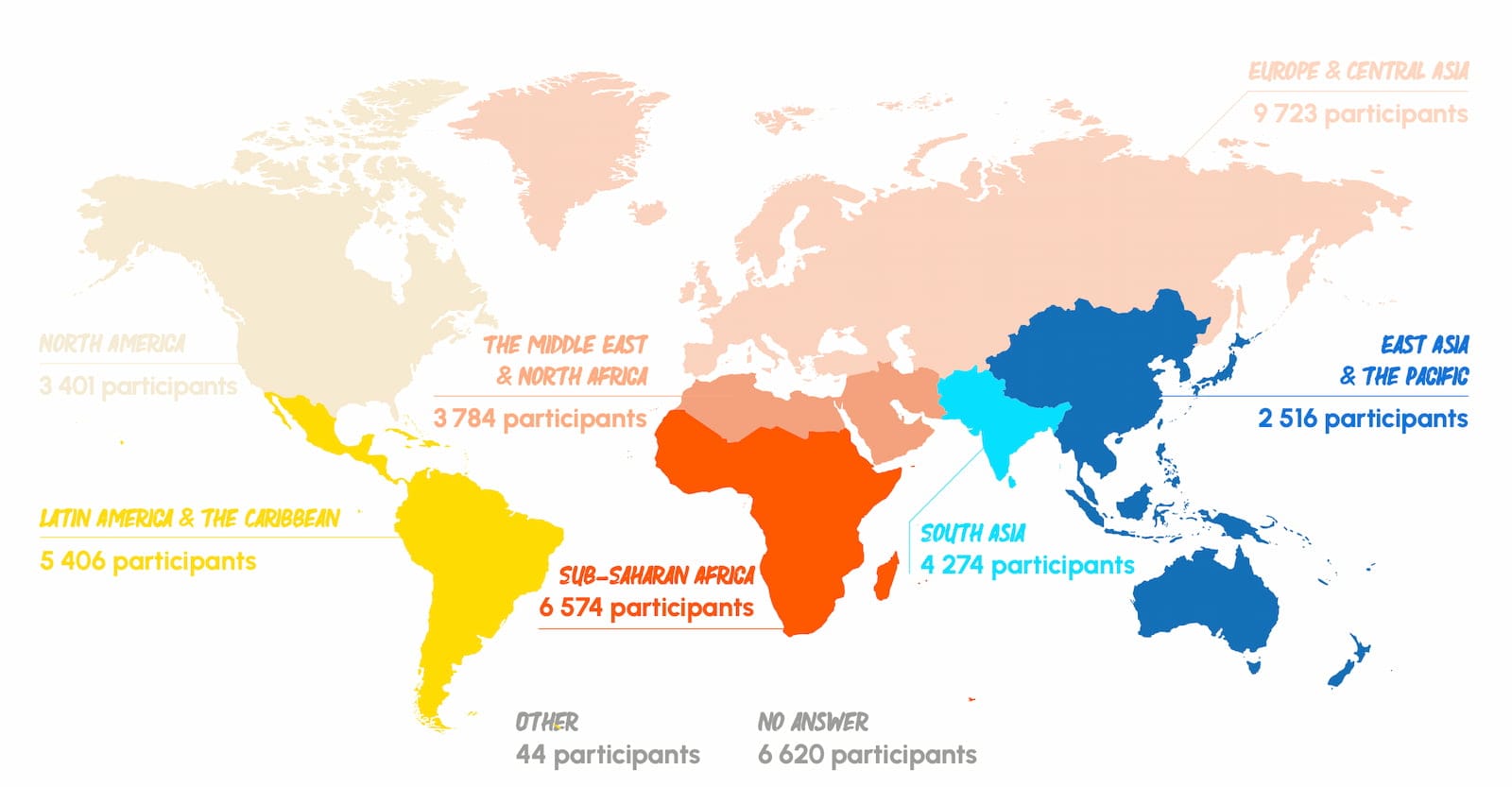
Click on the map to enlarge it.
What becomes
of the results?
The Youth Talks results are used to propel the voice of the youth on the global stage, turning it into a powerful tool to guide decision-makers, inform the critical decisions made about our future and transform our societies.
Those results nourish various types of documents adapted to address multiple target stakeholders that can help promote the youth vision further: educational institutions, companies, governments and political institutions, youth organizations, the media and the general public.
Youth Talks
founding members
Special collaboration with the UN-supported initiative Principles for Responsible Management Education (PRME) and the Club of Rome.




Partners of the initiative
See all the partnersAcademic Institutions


Global Institutions


Media Partner

Close to one million contributions, analysed with cutting-edge artificial intelligence and distilled into rich, comprehensible and actionable insights.
The voice of the youth, on the global stage.
